e-Gel indicating silica gel is used in many applications. However, its primary function is to adsorb moisture. In this post, we’ll look at the common uses of silica gel, as well as the applications across industries, storage and transport.
How Does Silica Gel Work?
Silica gel adsorbs moisture, to protect assets from rust But it’s important to note that this is not the same as absorb.
The word adsorb has a different meaning to absorb. Adsorb is to hold molecules on the outside of the structure – in this case the SiO2 – not taken “inside” the body of the SiO2, which would be absorbing.
Common Uses of Silica Gel
One of the most common uses of silica gel is in the electrical industry, specifically in moisture control for transformers. In this application there are bottles or chambers, commonly known as breathers. These breathers are plumbed in, to dry out the air that is sucked in from atmosphere into the transformer line. When the air passes through the breathers the e-gel that is filling the breather adsorbs the moisture form the air, so that when the air reaches the transformer line, the air is sufficiently dry.
Types of Breathers
There are options for the configuration of the breathers, such as:
- Disposable (these are simply unscrewed from the “tranny” line and a new one screwed in to place)
- Refillable breathers, (these are units that the spent gel can be emptied out of, then the breather can be re-charged with new/regenerated e-Gel)
- Certain breathers are designed with an oil bath
- Certain other breathers have valves in their base, to to control the flow of air in and out of the breathers
e-Gel for Storage & Transport Applications
Another popular use for e-Gel s in packaging of product so as to ensure suitability in storage and transport. DAYWALK specialises in asset protection and offers a range of different size e-Gel sachets. These are typically used as a moisture controller in palletised or other gear. So, if you have gear being stored for a substantial period of time and the items are potentially going to be damaged if there is any moisture ingress, look at the DAYWALK e-Gel sachets. As a rough rule of thumb allow 1 kg of e-Gel for 1 cubic metre and this will last between 6 and 12 months.
Protecting Mining Spares and Equipment During Storage
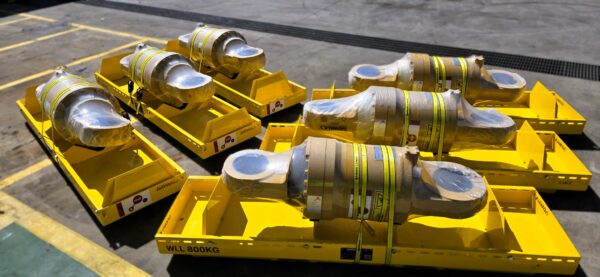
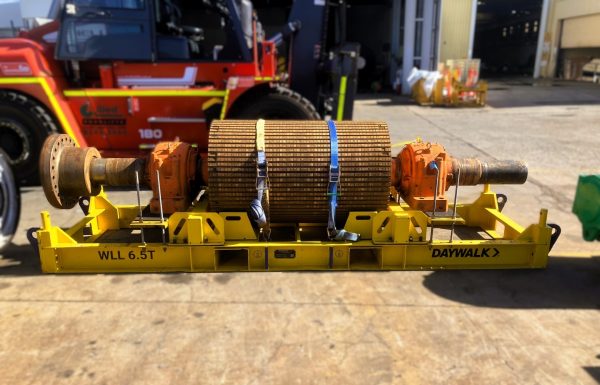
Silica gel also plays an important role in protecting mining spares, components and equipment during storage and transport. Critical spares can spend months in warehouses, workshops or equipment laydown areas before they are required. During this time, humidity and temperature changes can introduce moisture into packaging and create conditions that contribute to corrosion. This is particularly important for high-value components such as gearboxes, electric motors, hydraulic components, actuators, pumps, bearings and other maintenance spares. Using e-Gel inside sealed or appropriately protected packaging can help control moisture around the component and reduce the risk of corrosion during extended storage.
Equipment laydown areas present another challenge. Components may be stored outside or in partially enclosed areas while they wait for installation, repair or deployment. Where equipment is protected using suitable covers, wrapping or sealed packaging, e-Gel can provide an additional layer of moisture control inside the protected environment.
Silica Gel for Long-Haul Transport
Long-haul transport can also expose equipment and components to significant changes in temperature and humidity. Mining equipment and spares may travel thousands of kilometres by road, rail or sea before reaching their destination. Temperature fluctuations can cause condensation inside enclosed packaging, particularly when equipment moves between different climates. Using the appropriate quantity of e-Gel sachets inside sealed packaging can help manage this moisture risk during transport. This can be particularly useful for palletised components, spare parts, electrical equipment and other corrosion-sensitive items that need to arrive ready for use.
Lifespan of e-Gel
The good part about e-Gel is that there is a definite colour change, from orange to green; when you see green, it’s time to change the gel! A common question as to e-Gel is whether the customer is allowed to re-generate and re-use the e-Gel. Many sites do re-use e-Gel a second or third time. The end-user uses a drying process; 25kg of e-Gel will take approximately 4 hours to dry at 100⁰C to 120⁰C.
Every time you regenerate e-Gel, approximately 20% of the pores in the gel molecules will not re-open so that the drying ability will decrease each time you choose to regenerate the e-Gel. When the e-Gel is new it is orange, and once it is spent, it is dark green. When you re-generate the gel, the e-gel colour does change back to orange, however not always as bright as the original unspent colour.
As many would have already had experience, other applications for silica gel is for items of clothing, such as shoes and other footwear; also medical industry uses gel and other desiccants for keeping tablets absolutely dry. For further information about rust protection and e-Gel solutions, talk to our specialists at DAYWALK.